The following plants which are native to the Pacific Northwest either show scientific evidence to effectively treat health issues, or I have personally tested to work for me. However, many of them should only be used under the care and advice of a naturopathic physician. Don’t rely on internet advice to treat problems, and know that when an herbal remedy works for one person, it doesn’t necessarily work for another. Please click on my previous post Tenets of Herbal Medicine: Guidelines & Rules for Health, Safety & Success for suggested guidelines.
Plant Properties from Botany in a Day
 This article is designed to help the beginner cut out the chaff, and start studying the plants that will give a solid foundation of knowledge. But it’s not even the whole plant you need to learn: the properties inside the plant are what’s important. For that, the best essay I’ve ever found is in the appendix of Botany in a Day by Thomas J. Elpel. You really need to read his wonderful 10 page essay on herbal properties if you ever want to understand herbal medicine. Elpel outlines the plant properties this way:
1. Carbohydrates, inlcuding starches, monosaccharieds, disaccharides, polysaccharides like cellulose, inulin, mucilage, pectin, and gum.
2. Glycosides including sulfur clycosides, cyanide glycosides, and phenol glycodies like simple phenols, flavonoids, coumarins (dicoumarols and furanocoumarins), anthraquinone glycosides, cardiac glycosides, and saponins.
3. Acids including tannic acid, oxalic acid, citric and tartaric acid, and formic acid.
4. Acrids.
5. Latex.
6. Alkaloids (narcotic and otherwise) including indole alkaloids, quinoline alkaloids, isoquinoline alkaloids, purine alkaloids, pyrrolidine and tropane alkaloids, pyridine and piperidine alkaloids, pyrrolizidine and quinolizidine alkaloids, and terpenoid alkaloids.
7. Volatile or Essential Oils which are combinations of aroma
8. Resins.
9. Bitters.
10. Gelatin.
Most Important Native Medicinal Plants, Part 1: Non-Flowering Plants

Seaweeds: Of course algae are not plants, but rather the predecessors to plants, and they are classified on their own kingdom of life. Humans are nearly the only mammals I know that eat seaweed. According to Northwest seaweed specialist, Ryan Drum, Ph.D, all the seaweeds north of approximately the 40th parallel were considered edible as of the turn of the 21st century, whereas seaweed south of there may develop undetectable toxins due to warmer water, and more research needs to be done to test as climate change warms ocean water.
Seaweeds are divided into the “reds,” “browns,” and “greens.” Like the plant kingdom, algae contain myriad nutritional and medicinal constituents, so you should research the ones you eat to make sure you are not receiving too much of something, such as salts or other minerals like iodine. People inland are often deficient in both, which is why iodine is added to table salt. However, you can easily overdose in iodine. As for medicinal uses, seaweeds are very popular, and may offer future revelations for curing cancers and other maladies, but in the meantime, just read Medicinal Uses of Seaweeds by Ryan Drum, Ph.D. for a an introduction.
Lichen: Again, this is another form of life commonly thought of as a plant, but in reality, it is a fungus that cultivates algae! The most famous medicinal lichen are from the Usnea genus species, and there are many kinds here in the Pacific Northwest. Usnea species are easy to identify: just take some off alder, oak, apple or other tree branches, pull it apart slowly, and if you see a latex-like cord stretching out, then you’ve got it. Usnic acid is the compound inside this “plant” that seems to be the source of its medicine. In fact, usnic acid is used in many modern products like sunscreen and toothpaste for its anti-microbial properties to extend shelf life. A tincture would be best to draw-out the uscnic acid, but you can make a hot tea in case you need a strong antimicrobial in the backcountry.
From the Moss Division: I’ll include Sphagnum centrale or Peat Moss to demonstrate that this division includes non-vascular (no veins) spore plants, and especially because Sphagnum moss grows in bogs, where the water is highly acidic and rather inhospitable to bacteria. This may be one of the reasons Sphagnum moss was used to pack wounds, most famously in wars around the turn of the 20th century, and it’s still recommended today for use as feminine pads and other applications. Please note that there are about 15,000 other true mosses, plus other non-vascular spore-producing divisions, including about 100 Hornworts and about 10,000 Liverworts.
From the Club Moss Division: I’ll include the Lycopodium genus as an example in this division of vascular plants with about 1,000 species. Herbalists that I know recommend a couple of the species in this genus as an topical (not internal) anti-microbial styptic to stop bleeding. Also, something I learned from Botany in a Day is that club moss spores are sold as “vegetable sulpher” or powder to dust on diaper rashes, bed sores, and herpes eruptions. The spores contain a waxy substance that is soothing on the skin and it repels water.
From the Horsetail Division: There’s only one genus in the horsetail division, another vascular spore-producer, with 23 species worldwide. Here in North America, Equisetum avense or Scouring Rush has a high silica (glass-like) structural content, I have used it to clean, including as a toothbrush, but due to its many side effects, it should be used externally, or only under the care of a naturopathic physician.

From the Fern Division: There is a Grape Fern family, and a Water Fern family, but we are most familiar with the many species of the common Fern Family, containing 36 genera and 200 species in North America, out of the 170 genera and 8,000 species in this division world-wide. As an example of one popular fern used for medicine, Northwest herbalist, wildcrafter, and permaculturist Michael Pilarski gathers Licorice Fern, Polypodium glycyrrhiza also known as Polypodium vulgare which grows its rhizomes (root stems) through thick moss species it likes, especially on trees like Big Leaf Maple in wet climates. A couple of indigenous herbalists in our area have told me that the Licorice Fern rhizome is chewed for viral infections like sore throat and colds. Perhaps the volatile oils, supported by certain vitamins (C) and minerals (zinc), help cure viral infections faster than their normal duration, but this plant is intense (sucking on it, rather than chewing, is plenty strong) and needs further research.
Feeling Overwhelmed? Just Start with the Conifer Division
Learning plants can be overwhelming, so what I recommend to everyone is just start with conifers. There are only a few in any one area, and you can learn them in a day. Doing so will make it feel like you have a solid foundation from which to grow, and feel confident in one area of life, taxonomically speaking:)
The Pine Family is the largest, but it only contains 6 genera, and I bet there are 6 or fewer native pine species in your local area – don’t try to identify all the pines planted in yards since many are exotic. A change in elevation may add a few more to your area. For instance, in the lush Pacific Northwest coast, we have Grand Fir from the Abies genus, Sitka Spruce from the Picea genus, Lodgepole/Shore Pine from the Pinus genus, Douglas Fir from the Pseudotsuga genus, and Western Hemlock Tree from the Tsuga genus.
Anything else is a rarity, usually planted by someone, or found in one of the few remaining bogs, or at a high elevation, such as the Tamarack from the Larix genus which is common in boreal forests and northern Rockies. Most pine family trees have edible nuts, bark that is edible if prepared correctly (cambium from huge trees, chipped and fried), and high levels of vitamin C in their needles. Medicinally, pines are astringent and can be used where that effect is indicated, but historically, it is best know for its pitch which is used to patch cuts, but care should be exercised so as not to introduce infection.
The Yew Family includes 5 genera and 20 species worldwide, with 2 genera in North America. Most yew trees are highly poisonous, so this is one of two reasons why it is critical to identify them, as they are a look-alike to pine family trees like Tsuga and Abies. However, the most important reason to know yew trees, especially the Pacific Yew (Taxus Brevifolia), is for Taxol, a compound found in its bark that is responsible for the dramatic increase in breast cancer cure rates during the 1990’s. To that end, I really recommend reading the appendix chapter entitled “Testimony” in An Unspoken Hunger by Terry Tempest Williams which describes the importance of the Pacific Yew in dramatic terms following the death of her mother and sisters from cancer.

The Cedar / Cypress / Juniper Family includes great antifungals. The Western Red Cedar (Thuja plicata), for instance, is considered the Tree of Life along the Pacific Northwest Coastal areas because it doesn’t rot, in large part due to its antifungal qualities. Homes, boats, clothing and much more are made from cedar because it lasts a long time in wet climates where fungi otherwise thrive. However, some fungi can colonize, so just like there are numerous choices for antifungal cremes in the store, various cedar species will work against certain fungal infections. It is generally safe to try soaking your feet in a tea of cedar for athletes foot, or burn cedar and apply the cooled ash for jock-itch. However, if taken internally for black-throat, for instance, a naturopathic physician must advise.
This family of trees is not edible. The only species considered to have an edible aspect is the Juniperus for its berries if seeds are removed. It’s even easier to learn this family of trees than it is the pines, because besides Juniper, mostly growing throughout the Rocky Mountains, and Thuja mostly in the coastal Northwest, the other genera in North America include the Calocedrus with the Incense Cedar from Oregon and into the Rockies, the Chamaecyparis with the White Cedar in the east, and the Cupressus with the true Cypress in the southeast.
The Bald Cypress / Sequoia / Redwood Family is now lumped into the Cedar Family, but back when it was classified separately, it included 10 genera and 16 species worldwide, with just three in North America, including the Bald Cypress in the Taxodium genus, the Redwood in the Sequoia genus, and the Giant Sequoia in the Sequoiadendron genus. They have similar properties to the Cypress/Cedar/Juniper family, and along the same lines, they are the Trees of Life, in my opinion, due to climate change. Recently, it was shown that giant, old growth trees like these sequester more carbon than almost any other living thing. Further, the ones with anti-fungal and anti-microbial properties don’t rot very fast after they die. Therefore, they only slowly release into the atmosphere the carbon they sequestered when alive. If you live in the wet climates where these two families thrive, plant them wherever they will be allowed to grow into old age!
The Mormon Tea Family is the final non-flowering plant an herbalist should learn. Besides its common name being well known historically, its Latin name Ephedra has become well known in recent years as the source of Ephedrine, especially from the Chinese species Ma Huang, although the compound is also found in the species common to the American desert southwest. Ephedrine was used in weight-loss and energy supplements, but it lost favor after more than a dozen young people died when taking the drug in combination with exercise. It can still be found as a decongestant in commercial cold remedies.
Monocots

Grasses are perhaps the most important plant to our society, as their seeds are the grains we eat, their leaves the feed for our livestock and the thatched roofing material for houses, their stocks are where we get sugar (cane) and building materials (bamboo), and so much more. But as a medicine, one of the universal benefits of grass is for stomach aches. Just look at cats and dogs, who eat grass to cleanse their stomachs. There are many causes of stomach ache, including dehydration, appendicitis, food poisoning, constipation, etc., so to start testing its effects, and maybe just try wheat grass juicing to see how it effects you.
Cattails are probably the most important plant for you to know in survival situations. Take a look at my article on cattails for more information, but as a medicine, the gel found between the leaves seems to be a topical anesthetic (and some say antiseptic, but I’m not sure about that) so I’ve used it topically on a toothache as well as for sore joints with nice success.
Although not widely known for medicinal applications, let’s take a minute to mention Sedges, Rushes and all the Orchids including Lilies. They round-out the Monocot Division of the Plant Kingdom. First, to keep grasses, sedges and rushes straight, you can identify them by memorizing the following rhyme I first learned from herbalist Michael “Skeeter” Pilarski:
“Sedges have edges, Rushes are round, Grasses have leaves on stalks to the ground.” There are exceptions, of course, like Tules or “Bullrush” which look like big rushes but are apparently sedges, according to the latest taxometric classification. As for the orchid family including lilies, the native ones are probably fairly easy for you to identify in North America since they are relatively few. In the tropics, the opposite is the case: orchids are the largest family.
Dicots

Willow species were the source of Salicylic Acid, aka Aspirin, until it began to be synthetically produced in the 1950s. Willow, then, is a great pain-killer for headaches and certain other aches, but cannot be used when a person is bleeding because it thins the blood. To use, just make a decoction (simmer for a few minutes) of the bark and/or twigs, and drink a cup which can be somewhat equivalent to one or more aspirin, but that result varies widely based on species, plant part, time of year, and more. Also, remember that aspirin can cause the deadly Rye Syndrome in children, so it should not be used for young ones.
Plantain species, especially lance-leaf plantain, cure bee stings like nothing else in our experience. Just pick a leaf, chew, and spit the green mush onto a bee sting for immediate pain relief. It’s also astringent and draws things out, so don’t be surprised if the stinger is soon gone and you can’t find where you were stung after a few hours. Further, since anaphylaxis is a leading wilderness emergency, plantain may be attempted in case nothing stronger like benadryl is available in case of allergic reaction to stings. Finally, remember that the seeds of plantain are called psyllium, which is the main ingredient in Metamucil, used as a laxative to cure constipation.
Oregon Grape is another northwest backcountry plant which is proven to be anti-bacterial. In fact, although it is not closely related to Goldenseal, it is similarly used to treat bacterial infections because it contains the exact same medicinal compound (berberine) that makes life inhospitable for microbes. Although you can make a decoction of the roots if needed in the backcountry, making a tincture is probably the best way to draw out the antibacterials properties, so I carry some in my first aid kit that I made at home.

Devil’s Club is considered by many to be the most sacred medicine of our region, and it is used similarly to ginseng which is in the same family. If you have low energy, for instance, make a small, light decoction from its rhizome root, and drink a tablespoon to see how you feel later. However, don’t use too much or you’ll be sorry like some of my camp staff did (without permission) during a survival trek a few years ago: headaches all around:) Really, this plant works strongly on several systems of the body, so it will probably someday have its own commercial asking you to consult your physician about its benefits, and then spend half a minute listing its many side effects!
Nettles are very useful for many reasons, and you can read about their many herbal uses in a fun chapter by Susun Weed in her book Healing Wise, but traditionally, their external application (whipping) can stimulate blood flow to cure sore joints, while their internal consumption is great nutrition, especially to treat anemia after blood loss. In the meantime, take a look at my wife Kim’sarticle on nettles for more information.

Yarrow is known to increases body temperature or induce sweating when taken internally, so people use it as a tea (hot infusion) to treat colds and flu, hoping to stimulate killing of viruses. As Florence Nightingale popularized during the Crimean War well over a century ago, yarrow is also great for cuts, because when applied externally, it stops blood flow and helps wounds heal. I just apply the leaves straight on, but I’m not sure how antibacterial it is, so always take care to avoid infection by flushing simple wounds with pure water.
Arnica also seems to increase body temperature for some people, so it may ward off chills, or induce fever in case of colds. It’s also considered anti-bacterial when applied to wounds, so in addition to being anti-inflammatory, Arnica species can be a good choice for all kinds of trauma.
Cranberry species grow in bogs amongst the sphagnum moss, and cranberry is a scientifically-studied treatment for urinary tract infections, prevention of kidney stones, and general cleansing of body toxins. I grew up with it, and we still harvest cranberries from our lake in Wisconsin every September.
Pineapple Weed is the American chamomile, in the same genus as the cultivated German Chamomile, and it loves growing in our gravel driveway. It can be used in the same way, with a calming effect in case of stress, and a relaxing effect in case of insomnia.
Goosefoot species such as spinach, lamb’s quarters and quinoa, contain relatively high amounts of sodium for plants, and in fact, it does taste a bit salty, so for those of you who go overboard drinking all that water that they used to recommend in Wilderness First Aid trainings, and as a result get massive headaches due to lack of salt, goosefoot species can help reverse electrolyte sickness. Dandelion and chicory, the latter two being diuretics, might also be options in order to regain your balance between electrolytes (salt, potassium and other minerals) and water in your cells.
Red Alder and oaks are great trees to cleanse the skin, as the tannic acids create an inhospitable habitat for bacteria, so if you don’t have any soap, at least rinse your hands with an alder decoction before eating and after eliminating. See my article on oaks for more information.

Rubus species, aka blackberries and raspberries, are incredibly useful beyond the sugars and vitamin C provided by the berries. Same for almost all the plants in the rose family to which they belong. Their flowers are also edible, but blackberries and their leaves are also high in iron, so can help against anemia, and leaves are also very astringent, so can treat loose bowels as well. Thimbleberry leaf, I have discovered, cures my hay fever, especially grass allergies. Just blow your nose into the soft leaf, then take another and breathe through it like a particle mask.
Elder species are also very important plants, including for medicine in the backcountry. I keep some of its leaves around when I don’t have a tent because it confuses mosquitos. It is also my saving grace, along with chickweed, when I have a flair-up of asthma, which happens after too much exposure to allergens like grass. Elder flowers are the strongest of medicine, and care must be taken when using them, but the fruits are prized as medicine as well. Just don’t eat the seeds, especially those from red elder, as they are poisonous, similar to apple seeds.
Mint species are great in case you have heat exhaustion, as they have a cooling effect, so just eating a leaf helps, as does a cold infusion (leaves soaked in water), or if you have a headache from heat, you can also rub mint leaves on your scalp. I got sick on moldy mint in the wilderness one time, so it tends to give me headaches now. Therefore, like all these suggestions, test them carefully for personal preferences.
Cottonwood is one of the poplar species, the source of Balm of Gilead which is a mixture of poplar buds and something like bee’s wax to make a salve for rashes, eczema, sun-burn, and other skin irritations. Cottonwood buds are the most aromatic amongst poplars, so we are fortunate to have them in western North America.
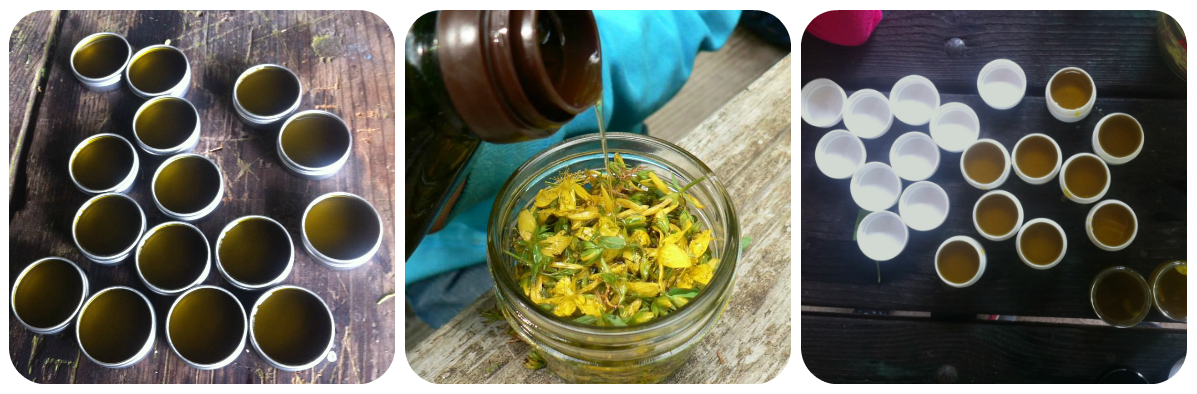
St. John’s Wort also grows along sunny/gravelly patches of our region, such as on logging roads or fields, and it is a popular anti-depressant, although scientific studies have been totally inconclusive. Try it as a tea in case you are feeling melancholic, especially on dark days, because taken internally, it makes you sensitive to light, increasing sun-burn. What it actually does is effect our nervous system, rather than chemicals like saretonin which are the issue with most depression. Used externally, it ironically has skin-healing properties – actually the nerves under the skin – so I put it in my salves nowadays.
Dock. We haven’t talked very much about bowel health yet, and dock species, including Yellow or Curly Dock, and Burdock, like Dandelion, are great roots to eat regularly, to um, keep you regular, with clean intestines.
Cascara Sagrada (sacred bark in translation from the latin origin) is an understory tree in our region that was almost logged to extinction (a hundred years ago, before pharmaceutical reproductions) in some places due to its effectiveness as a laxative. So if you have constipation, make a decoction from its bark.
Cherry includes a variety of edible and inedible species, but in our area, the Black Cherry has bark/sap that is not palatable. It is a strong expectorant that you’ll find in many over-the-counter cough medicines, but you should consult a naturopathic physician for use, and be very careful in the backcountry to treat wet (productive) coughs only.
Mullein is one of my favorite plants during hikes into the backcountry of central Washington, and it is another treatment for coughs, but this time, if you make an hot infusion (tea) from its flowers, or a light decoction from its leaves, it should be used to treat “dry cough” in my experience, as it soothes the throat and heals the lungs. Some people smoke the leaves, which might be good for wet coughs, so again, it’s best to research, research, research!
Pearly Everlasting grows along most logging roads and elsewhere in our backcountry. Its flowers are one of my favorite substitutes for lotion, keeping my skin soft and young-looking:) It blooms from summer through fall, so it is available for half of our year.
Tansy is invasive in our area, but helps keep bugs away if you surround yourself with it, or rub it onto your skin, but like anything, it’s best to check for allergic reactions at home before using any of these plants for the first time in wilderness settings.
Learn how to confidently identify plants using their unique family patterns in this in-depth video by author of Botany in a Day, Thomas Elpel.
*** For educational purposes only. This information has not been evaluated by the Food and Drug Administration. This information is not intended to diagnose, treat, cure or prevent any disease. We recommend that you consult with a qualified health care practitioner before using herbal products, particularly if you are pregnant, nursing or on any medications. ***
*** Please read our Honorable Harvesting Guidelines before harvesting any plant material. The final guideline is of utmost importance: “Never put anything in your mouth unless you are 100% sure it is safe to ingest.” ***
Article author Chris Chisholm is founder and co-owner of Wolf Camp & School of Natural Science. For in-depth learning, join our Weekly Online Classes
Discover more from Wolf Camp & School of Natural Science
Subscribe to get the latest posts sent to your email.